Jewelry quality terms, decoded: a wholesale buyer’s materials guide
Every jewelry listing is a spec sheet in disguise. Learn to read the material line and you can predict how a piece will wear, who it suits, and what your returns inbox will look like in six months.
Key takeaways
- The material line on a listing tells you more about how a piece will perform than the photograph does.
- “18K gold plated” describes the gold used in the plating layer, not how much of it is there. Thickness decides lifespan, and it is rarely stated.
- Stainless steel, copper, alloy, and sterling silver each suit a different customer and price point. None is the right answer for a whole range.
- Terms like waterproof, hypoallergenic, and tarnish free describe intent, not certification. Read them as claims about the base metal underneath.
- A strong assortment spans quality tiers on purpose, so you can serve the daily-wear customer and the occasion buyer from the same shelf.
You’ve probably done this. A piece catches your eye on a product page, the photography is good, the price works, and you add it to the order. Somewhere below the image sits a line of text: 304 stainless steel, 18K gold plated, zircon inlaid, artificial pearl. You skim it. It reads like specification noise.
It’s not noise. That line is the most useful thing on the page, and it’s the closest you can get to holding the piece before it arrives.
Why jewelry material matters more than the photo
Photography flattens the differences that matter. A gold plated copper ring and a solid sterling ring can look nearly identical in a lightbox, and both will look excellent on your shelf on day one. The difference shows up on the customer’s hand in week six, which is also when it shows up in your reviews.
Jewelry material determines weight, how the piece feels when someone picks it up, whether it darkens, whether it reacts with skin, and how it survives a shower. Those are the things a customer notices after the sale, and they’re all predictable from the listing if you know what you are reading.
If you are extending a jewelry line you already carry, or adding the category alongside what you stock now, this is the one piece of vocabulary the rest of your buying experience doesn’t transfer. You know how to read a margin and a sell-through rate. Jewelry just has its own material language sitting on top.
None of what follows is about avoiding certain materials. A stainless steel piece at its price point is exactly right for the customer buying it. This is about matching material to the person you are selling to, which is a more useful skill than a blanket rule about what to stock.
Base metals: what the piece is actually made of
The base metal is the body of the piece. Everything else, plating included, sits on top of it.
Stainless steel
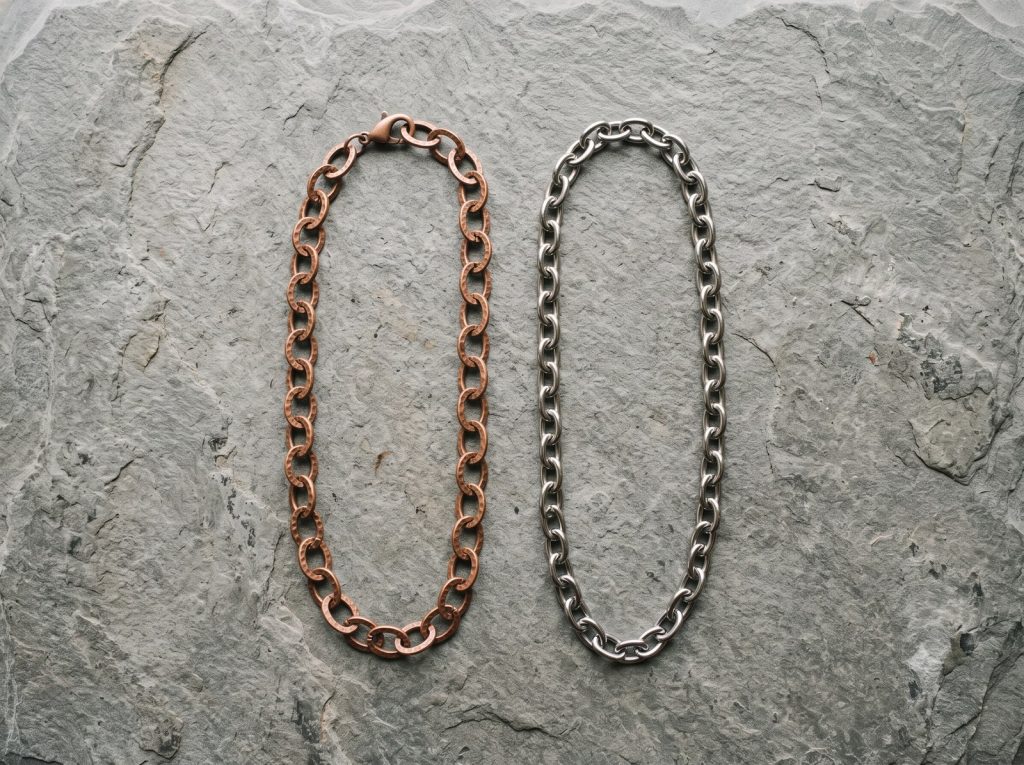
The workhorse of fashion jewelry. It resists tarnish, tolerates water, holds a polish, and is comfortable for most people to wear daily. If a listing specifies a grade, that’s a good sign: 304 is the common general-purpose grade, while 316L contains molybdenum and handles moisture and salt better, which matters for anything a customer will swim in or wear at the beach.
You’ll also see the term titanium steel in listings. It generally refers to the same family of stainless alloys and is a sourcing-side habit rather than a different material. Read it as stainless.
Best for: everyday pieces, men’s jewelry, anything sold on durability. Browse the stainless steel range to see how wide the category runs.
Copper and brass
Copper is soft, warm-toned, and takes plating beautifully, which is why so much delicate fashion jewelry is built on it. Brass is copper mixed with zinc, harder and more yellow.
Both will tarnish with air and skin contact, and copper is the reason some customers report green marks. That’s a normal reaction between copper and skin acidity, not a defect, and it happens faster on people with more acidic skin and in humid climates. Plating slows it. It doesn’t stop it forever.
Best for: fashion-led, trend-driven, occasion pieces where visual detail matters more than years of wear. See the brass range.
Alloy
Alloy is a catch-all for mixed non-precious metals, often zinc-based. It’s light, castable into intricate shapes, and inexpensive to produce, which is why statement earrings and charm-heavy designs so often use it.
The thing to watch is nickel, the most common metal allergen. If a piece is alloy and will touch skin for long periods, look for what sits at the contact point. A well-made alloy earring often pairs the decorative body with a sterling silver or stainless earring post, which is a deliberate design choice and a genuine signal of care.
Best for: statement pieces, seasonal trends, styles you want to test before buying deep. See the alloy range.
Sterling silver
The 925 hallmark, sometimes written S925, means 92.5 percent pure silver with the remainder usually copper for strength. Pure silver on its own is too soft to hold a setting.
Sterling tarnishes, which surprises customers who expect precious metal to be maintenance-free. That’s worth pre-empting at the point of sale rather than discovering through returns. It also polishes back, which pure fashion metals do not.
Best for: gift purchases, engagement and occasion pieces, customers who ask what something is made of before they buy.
Base metals at a glance
What each jewelry material means for wear, and who it suits.
| Material | Tarnish resistance | Water tolerance | Best suited to |
|---|---|---|---|
| Stainless steel | High | High, higher still at 316L | Everyday wear, men’s jewelry, durability-led pieces |
| Copper | Low | Low | Delicate, detail-rich fashion pieces |
| Brass | Low to moderate | Low | Warm-toned statement and vintage styles |
| Alloy | Varies by finish | Low | Statement pieces, seasonal trends, testing new styles |
| 925 sterling silver | Moderate, polishes back | Moderate | Gifting, occasion pieces, considered purchases |
Plating and finish: what is on top, and how long it lasts
This is the section most buyers misread, so it’s worth slowing down.
“18K gold plated” tells you the karat of the gold in the plating layer. It doesn’t tell you how much gold is there. The number describes purity, not quantity, and the quantity is what determines how long the finish survives.
That quantity is plating thickness, and it’s the single most important variable in how a plated piece ages. It’s also almost never stated on a listing. Two pieces can both say 18K gold plated and wear completely differently.
So what can you actually judge?
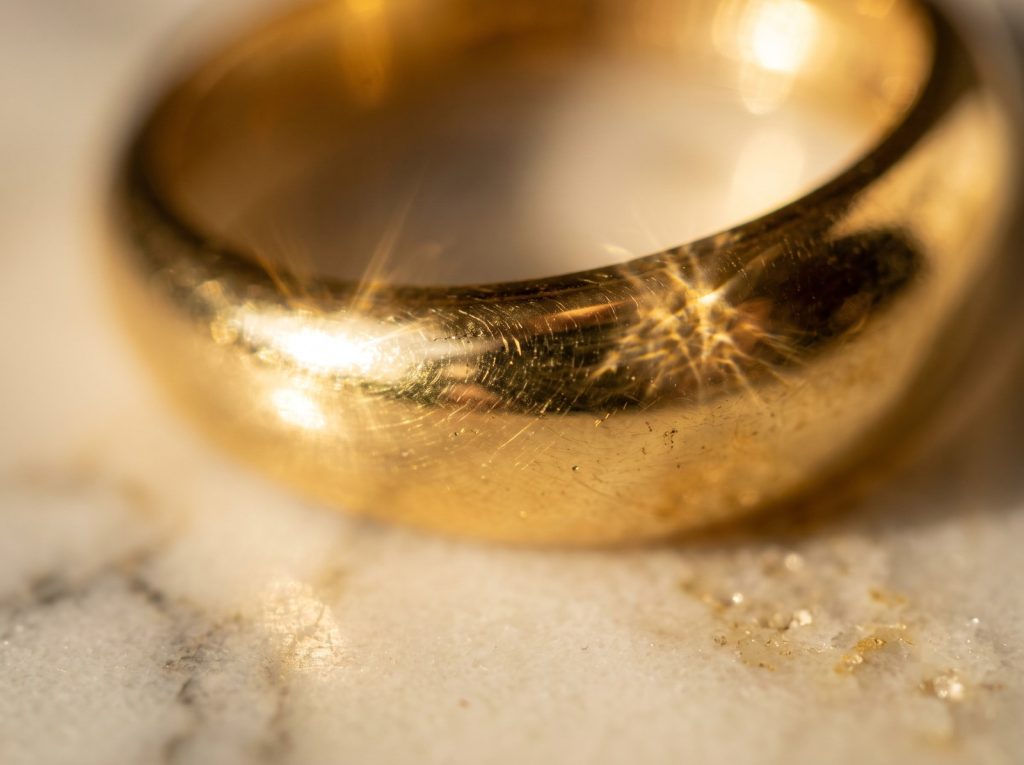
The base metal underneath, because plating over stainless outlasts plating over soft copper. The finish process, where PVD plating bonds a harder, more wear-resistant layer than standard electroplating and is worth paying for on daily-wear pieces. And the intended use, since a piece described as waterproof or tarnish free is telling you what it was built to withstand.
Which brings up the language around wear. Waterproof, non-fading, tarnish free, hypoallergenic: none of these are certified terms. They describe what a maker intends the piece to do. Read them as claims about the base metal rather than promises, and weight them accordingly. Hypoallergenic in particular usually means nickel-free at the contact points, which is meaningful, but it’s a design intention rather than a medical guarantee.
Stones: real, lab-created, and simulated
Three categories, frequently confused.
Grown in a lab.Lab-created gemstones and moissanite are real crystalline materials produced under controlled conditions rather than mined. Moissanite is silicon carbide and sits at 9.25 on the Mohs hardness scale, which makes it genuinely durable for daily wear and gives it more visible fire than cubic zirconia.
Simulated. Cubic zirconia is a synthetic material cut to look like diamond. It’s the most common clear stone in fashion jewelry and performs well for its price. One thing worth knowing: listings often shorten it to zircon or zirconia, and buyers assume those are different products. In practice, a listing saying zircon almost always means cubic zirconia. Natural zircon is a separate and genuinely rare mineral, and you’ll not find it at fashion pricing.
Rhinestone means glass or acrylic, usually foil-backed for sparkle. It’s set, not grown, and it can loosen over time, which makes setting quality the thing to inspect.
Organic. Freshwater pearls are cultivated in mollusks and are real. Artificial pearl means a glass or resin bead with a pearlescent coating. You’ll see faux artificial pearl and imitation artificial pearl in listings too; treat them as the same thing. Mother of pearl is different again: it’s the iridescent shell lining, and it’s genuinely organic.
Natural stone covers everything from tiger eye to labradorite to obsidian, and variation between pieces is inherent rather than a flaw. Say so on your product page and it becomes a selling point instead of a complaint.
Reading a listing like an inspector
Four things to check, in order, before you commit to an order.
The base metal, not just the finish. Gold plated tells you the top layer. Ask what it sits on.
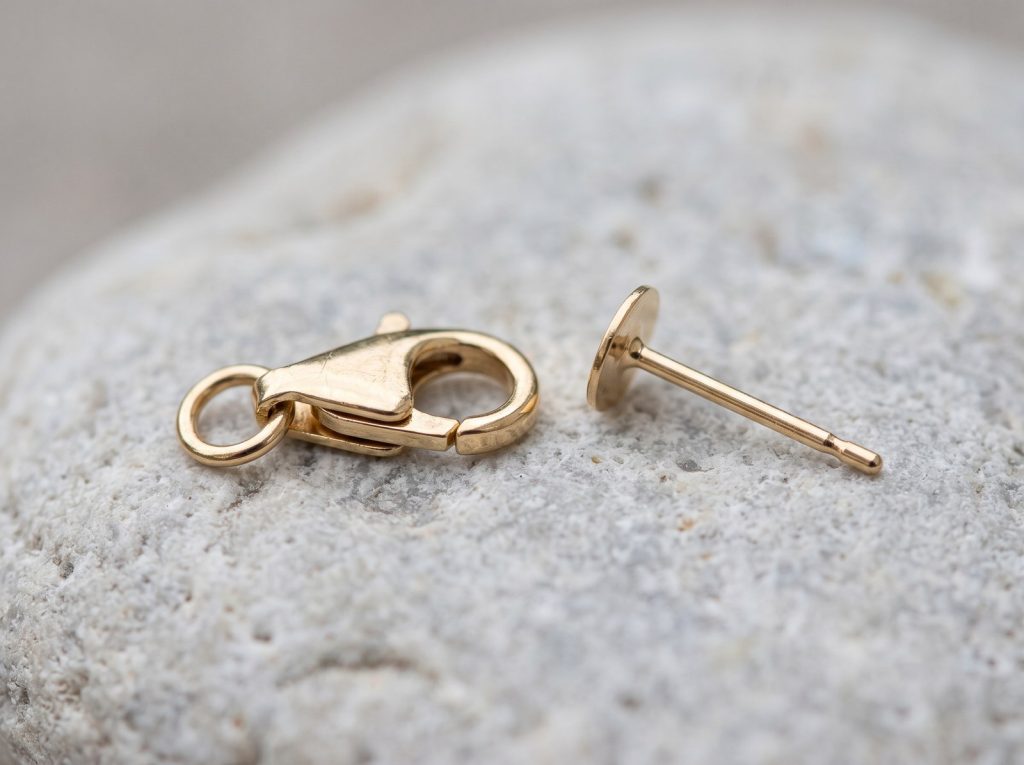
The contact points. Earring posts, clasps, the inside of a ring band. This is where allergies and complaints originate, and where good makers spend money.
The setting. Inlaid, pave, and prong-set each behave differently over time. Stones that sit proud of the metal take more knocks than stones set flush.
The closure. A lobster clasp on a chain, a slider on an adjustable necklace, a magnetic closure on a bracelet. Clasps are the most common failure point in returned jewelry and the least photographed part of any piece.
The instinct is to find the best material and stock it. That’s the wrong shape for most stores.
What high quality jewelry means at each price point
High quality jewelry isn’t one thing. At the top of your range it means solid sterling, a lab-created stone, and a setting that holds. In the middle it means stainless steel that survives daily wear and still looks sharp after a year. At entry level it means alloy that’s well finished, with a comfortable post and a clasp that doesn’t fail.
How to build a range across quality tiers
Quality is whether the piece does what the customer expected it to do. Judged that way, every tier can be high quality, and every tier can also miss.
Your customer buying a gift wants sterling or a lab-created stone and will pay for it. Your customer buying something to wear to a wedding wants alloy with real visual impact at a price that doesn’t sting. Your customer replacing something they wear every day wants stainless.
Those are three different customers, and a range built for one of them sends the other two somewhere else.
Testing a tier before you buy deep
If you are extending an existing jewelry line, or adding the category for the first time, the useful move is to buy narrow across several tiers rather than deep into one. Being able to source without minimums makes that practical: put a small quantity of each on the shelf, see what your specific customer reaches for, then commit.
The vocabulary is what makes that deliberate rather than accidental. Once you can read the material line, you are not guessing at quality from a photograph. You are buying to a spec, and you can tell your customer exactly what they’re getting.
Every Everful order is inspected against that spec before it ships, and our guarantees cover it if something arrives wrong.
Check before you order
- Read the base metal first: stainless for daily wear, alloy for statement pieces, sterling for gifting.
- Check the contact points: posts, clasps, and ring interiors, where allergies and complaints start.
- Read the plating method: PVD bonds a harder layer than standard electroplating, and thickness decides lifespan.
- Confirm the stone and the closure: know lab-created from simulated, and inspect the clasp, the most common failure point.