Holiday packaging for retailers: bags, boxes, and presentation
Packaging is the one Q4 category most retailers source last and sell hardest. It sits at the register when the buying decision is already made, it makes everything around it look more expensive, and it is the difference between selling a bracelet and selling a bracelet in a box. Here is what to stock.
Key takeaways
- Treat packaging as merchandise, not overhead. A gift box is a product with its own margin, sitting beside a customer who has already decided to buy something.
- Let the product pick the format. Bags for soft goods and speed at the counter, boxes for fragile and structured items and for the reveal.
- Judge a sample in under a minute: paper weight, handle and stitch, whether the corners hold square, and print registration on the pattern.
- Hold two or three colours across bags, boxes, ribbons and tissue. One neutral, one metallic, one seasonal accent carries past December.
- Build depth across price tiers. Entry moves at volume, mid carries the margin, and one genuinely premium box makes the mid box look like the sensible choice.
- Everful is factory-direct with no minimums, so a packaging test costs a few units rather than a case. Set the wider calendar with holiday inventory planning.
It is that time of year when retailers start holiday planning, and you are ahead of it. You have ordered and tested a few pieces per category, and you know what will land with your customers. But one component tends to get missed: holiday gift packaging.
Packaging is usually sourced last, and it should not be. Your shoppers are busy through the season and they want to buy a gift and what it goes in without making a second stop. Treat packaging as its own category and it earns a place in your holiday inventory planning alongside everything else.
What follows walks through the formats worth stocking, the materials that read premium, how to merchandise it, and how to test gift wrapping supplies with no minimums, meaning the ability to order one item or a thousand with no order floor.
Why holiday packaging matters for Q4 sales
During the holiday season your retail presentation matters more than it does all year, and it starts with perceived value. If a shopper is buying a bracelet and sees it already displayed in a gift-ready box, they want the box too. Showing the item packaged raises what the item appears to be worth, and putting the materials to achieve that look within reach turns the browse into two sales instead of one.
That is the whole argument for treating packaging as merchandise rather than as a supply cost. A gift box is not overhead you absorb at the counter. It is a product with its own margin, sitting next to a customer who has already decided to buy something.
When to use bags vs. boxes
The choice between gift bags and gift boxes is worth making deliberately rather than by whatever is in the stockroom.
Bags work better for soft, flexible items like apparel, scarves, and plush toys. They move faster at the counter and they take tissue paper easily, which is what lets a member of staff finish a gift in twenty seconds on a busy Saturday.
Boxes are better for fragile items and for gift sets. They hold their shape, so they stack and layer in a display in a way bags cannot, and they sell well at the register. Premium folding boxes read as considered for jewelry, cosmetics, and specialty sets.
Materials that feel premium during the holidays
Beyond the format, the material carries most of the impression. Light, flimsy packaging undercuts whatever is inside it, no matter what the item cost. Matte finishes, heavyweight paper, fabric bags, and cotton ribbon do the opposite.
Paper is worth stocking deliberately, and the consumer preference for it is real. A 2025 Trend Tracker survey from Two Sides North America, a paper industry association, found 52% of US consumers prefer their online orders packaged in paper. Read it knowing who published it, but the direction matches what most retailers see at the counter.
How to evaluate a packaging sample before you commit
Four things tell you almost everything, and all four take under a minute. Check the weight of the paper or board between your fingers, because grammage is the single best predictor of whether a bag survives a car boot. Check the handle attachment on a bag and the stitching on anything fabric, since that is the first thing to fail. Check whether a box holds its corners square when you lift it by one edge. And check the print, because misregistered foil on a holiday pattern is obvious on a shelf and invisible in a catalog photo.
Gift bags: sizes, materials, and holiday styles
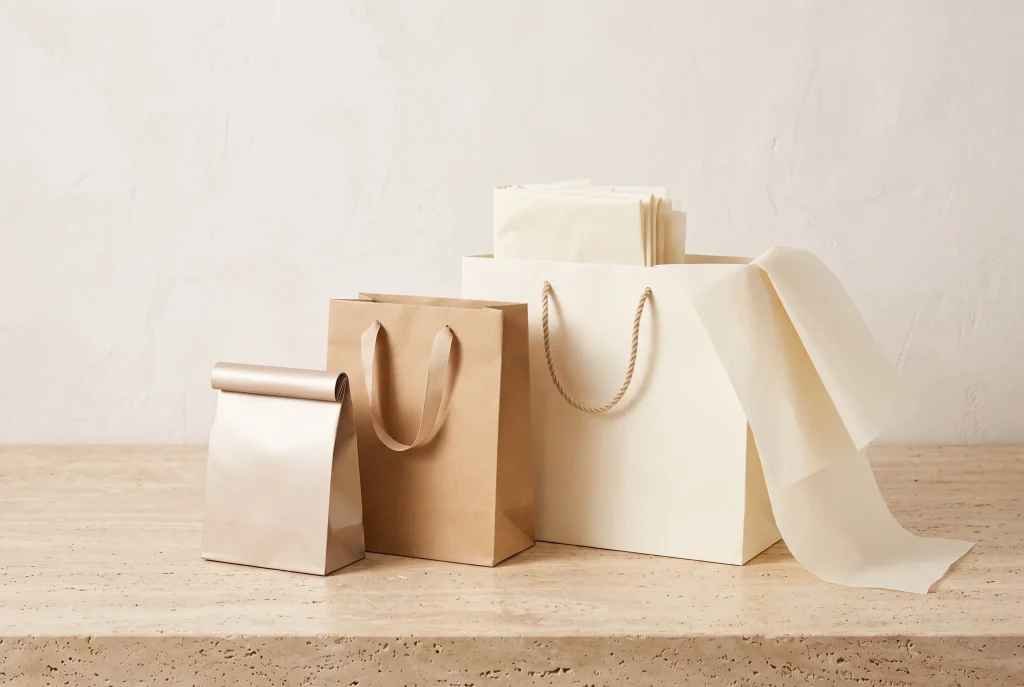
With gift bags there is more to weigh than it first appears. Size, material, and colour all make an impression.
Size. Choose sizes against what you actually stock. Small for jewelry and accessories, medium for apparel and home goods, large for bundled items.
Material. Heavyweight paper with reinforced handles holds up through the season. Fabric and jute bags get reused long after the holidays, which makes the bag part of the gift rather than the wrapper around it.
Colour. Holiday-specific palettes work, whether that is jewel tones, metallics, or classic red and green. So do neutrals, which read modern and elevated and have the advantage of selling after December.
How to build a cohesive holiday color palette
Pick two or three colours and hold the line across bags, boxes, ribbons, and tissue. A shopper putting together a gift from four separate displays should be able to grab one of each without thinking about whether they go together, and if they cannot, most of them will buy one item instead of four.
The simplest version of this is one neutral, one metallic, and one seasonal accent. It photographs well, it merchandises in any corner of the store, and the neutral and metallic carry through to birthdays and weddings once the season is over.
Gift boxes: rigid, magnetic, fold-flat, and jewelry boxes
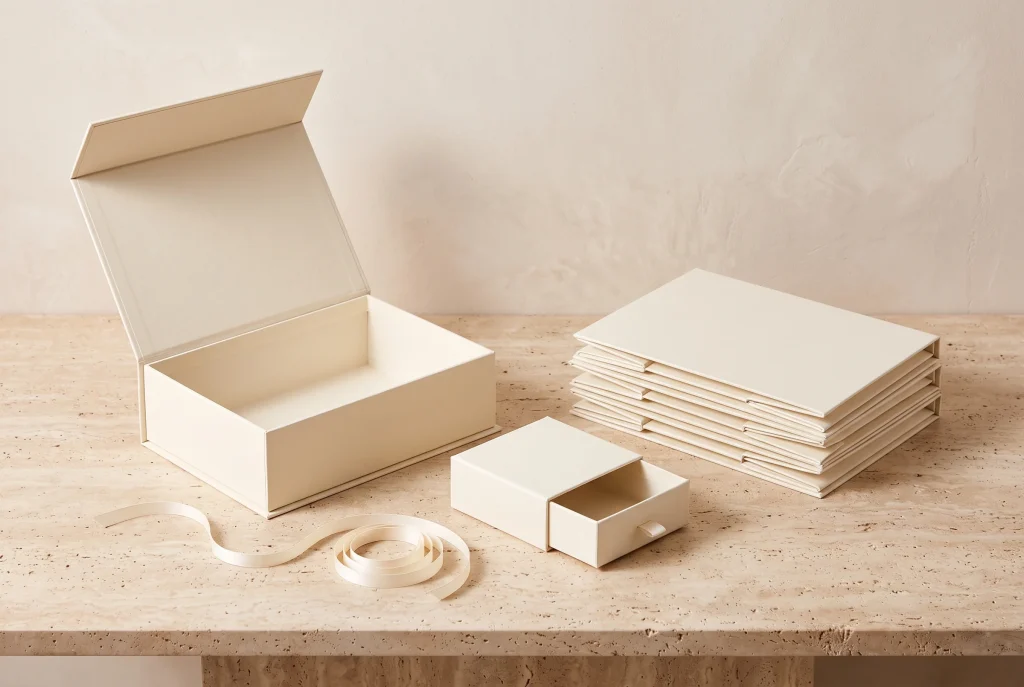
Gift boxes make a statement. A rigid box, meaning one that is structured and does not fold flat, reads as higher quality than a flimsy alternative on sight. A magnetic closure sets up the reveal, which is the part of gifting people remember. Sturdy boxes also get reused, which puts your packaging in someone’s cupboard until next year.
For online orders, a fold-flat box, meaning a collapsible one that ships compactly, gives you the same finish without the freight cost of shipping air.
Build depth across price points rather than picking one tier. An entry box moves at volume and covers the shopper who wants the item to look finished. A mid box is where most of the margin sits. One genuinely premium rigid or magnetic option lifts the average basket and, just as usefully, makes the mid box look like the sensible choice.
Jewelry packaging options for small gifts
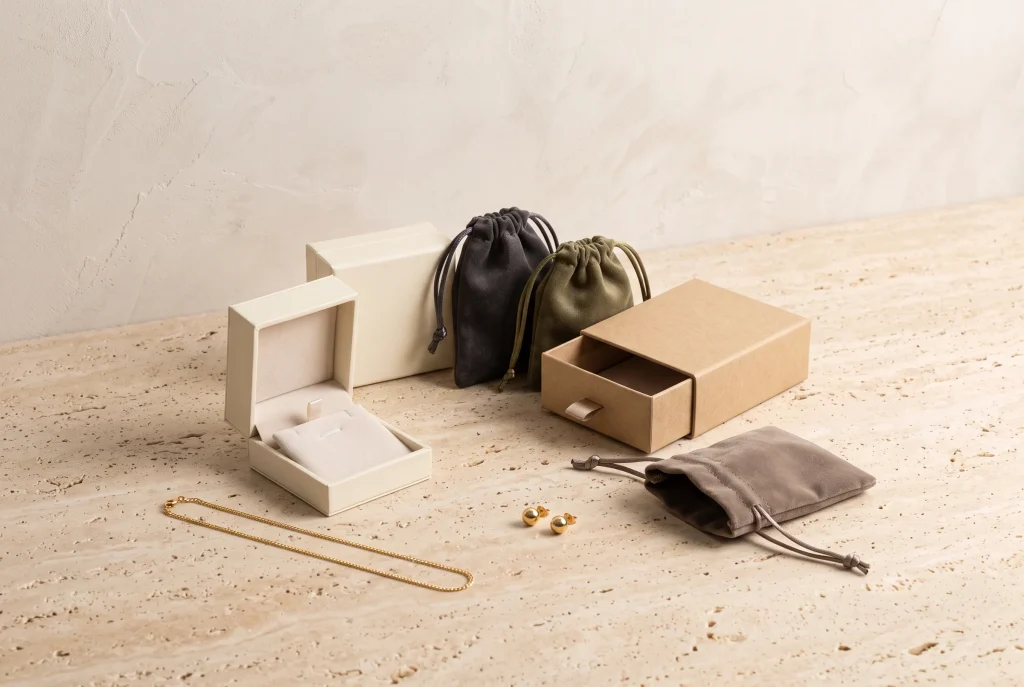
Small pieces need their own thinking. Jewelry boxes have to read as considered at a size where there is nowhere to hide, and the holidays are when jewelry gift sets come into their own.
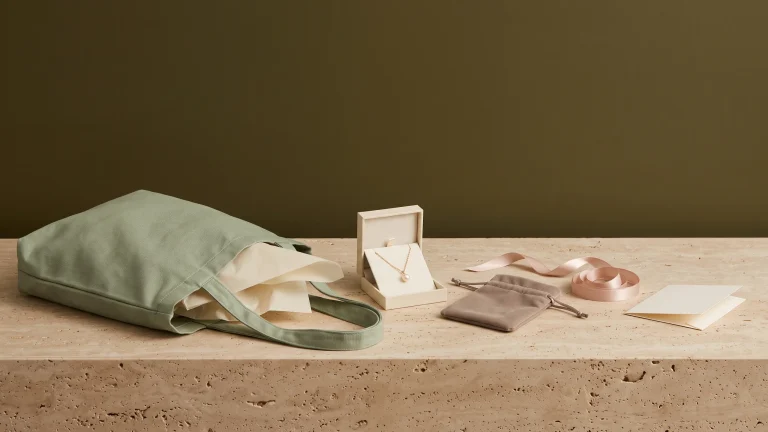
Sets are often sold pre-packaged, and that is something you can assemble in store from stock you already hold. The useful part is that the same boxes and pouches you use to build those sets can also be sold on their own, for earrings, rings, and small accessories. One buy, two revenue lines.
Items that need no further packaging are ready-to-gift, and they are worth identifying in your assortment, meaning the range of products you choose to stock. They are the fastest thing you sell in the last week before Christmas, when nobody has time to assemble anything.
Pouches, tags, and ribbons: small details that elevate presentation
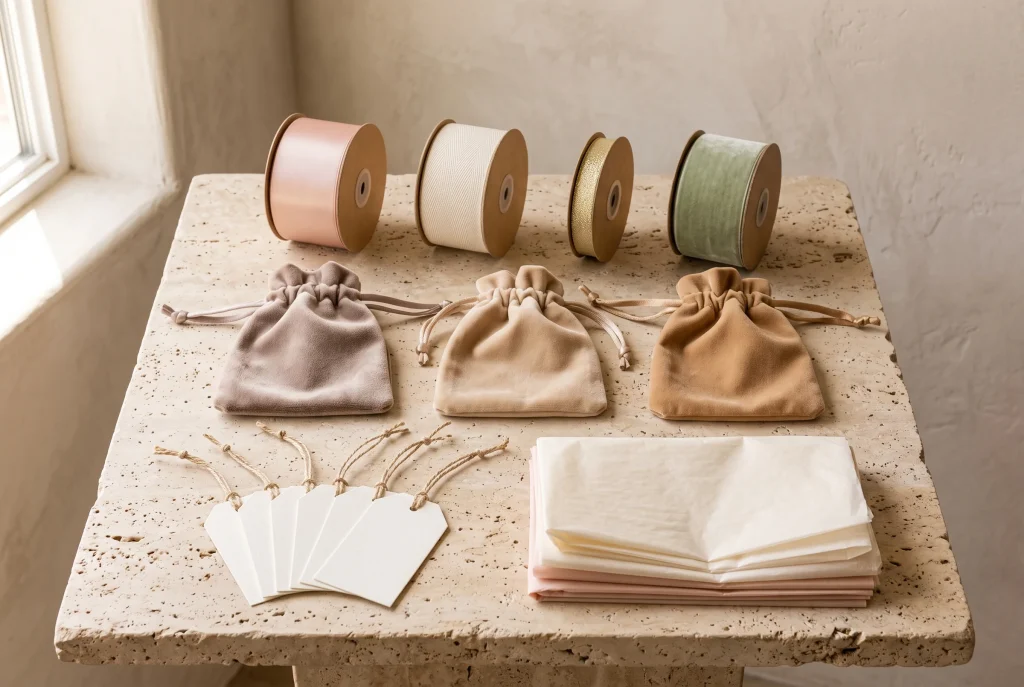
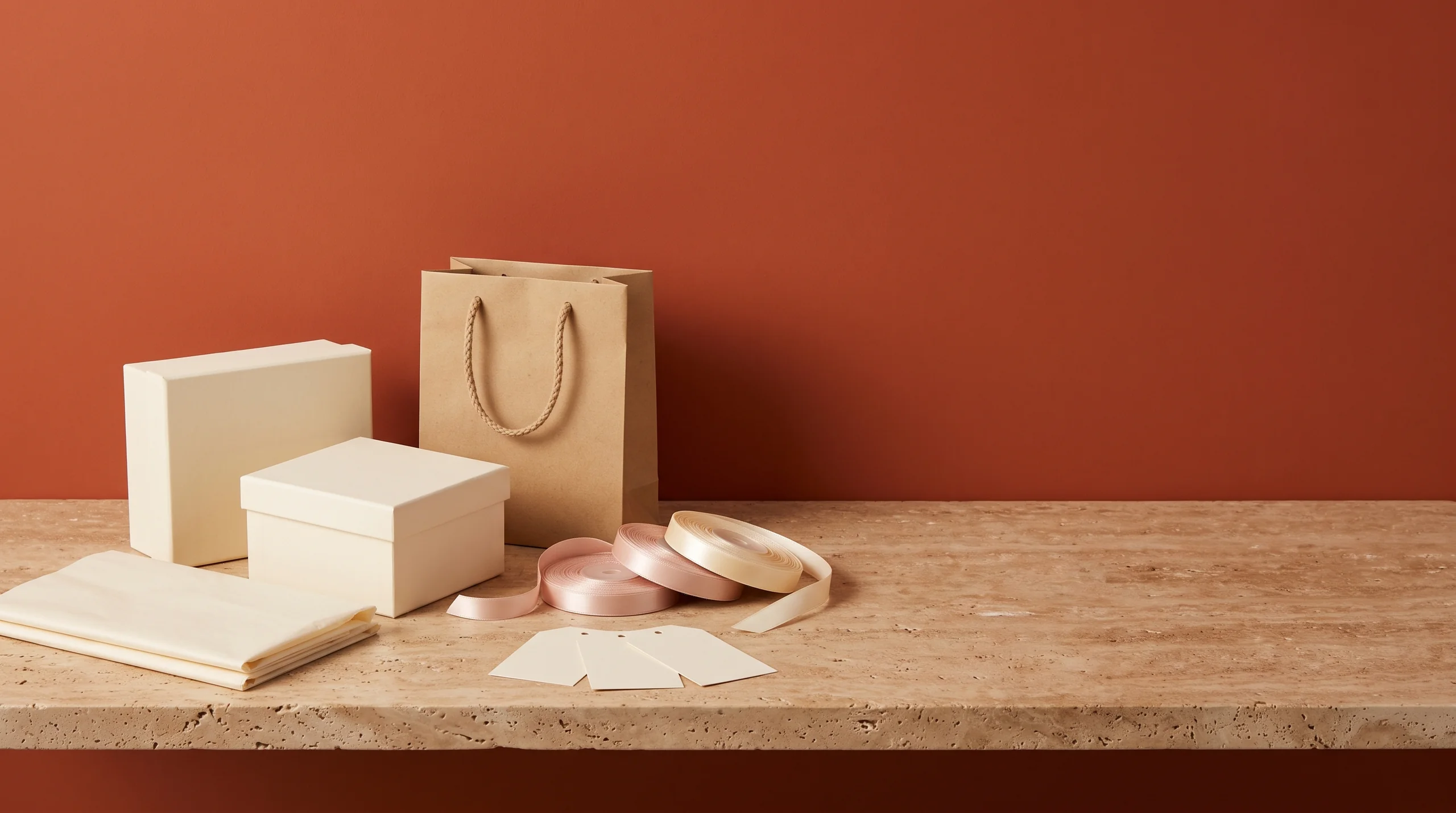
Rather than handing a customer a box, think about what makes it feel finished. Heavy tissue paper and velvet pouches inside, weighted cardstock tags and fabric ribbon outside. Each is small, low-cost to stock, and high-margin, and together they are what separates a gift that looks bought from one that looks chosen.
They also solve the second-trip problem. A shopper who can pick up the tag and the ribbon in the same visit does not go elsewhere for them.
If a customer asks whether you can put their company’s name on any of it, that is a different job with its own lead times. Our guide to custom-branded gift sets covers how custom branding works and what it does to a holiday calendar.
How to merchandise holiday packaging in-store
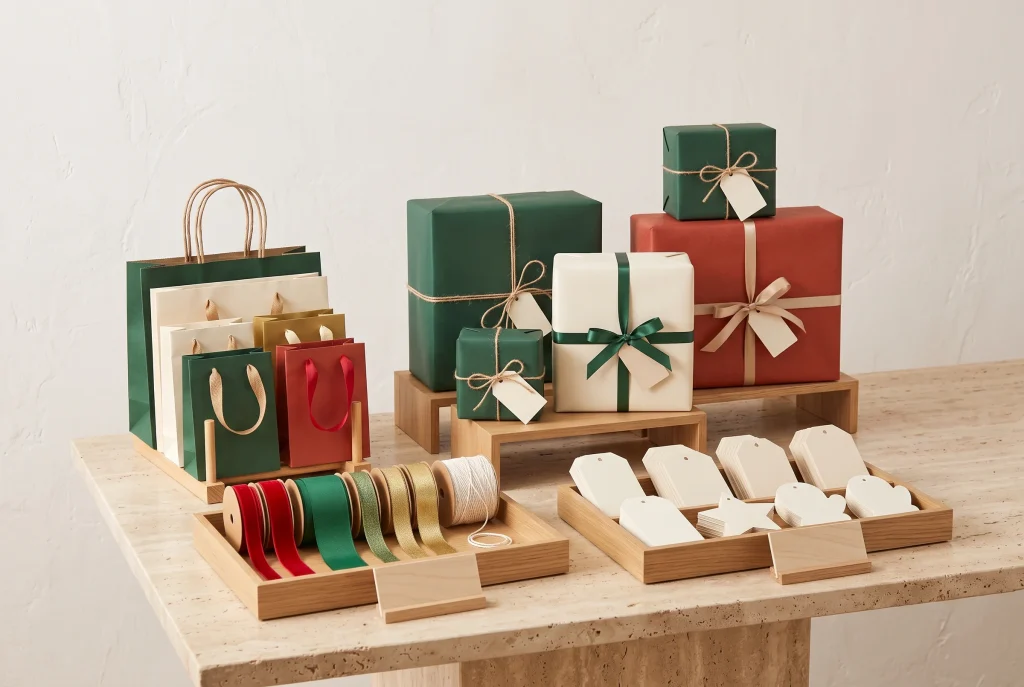
Put packaging into the presentation rather than behind the counter. Three ways to do it.
Wrap a few items and display them. Use different box sizes, hold your palette, and build something layered enough that a shopper can see what their own gift would look like.
Build a gift wrapping section. Group packaging, tissue, tags, bags, ribbons, and bows by colour or theme so a shopper can assemble a coherent look without crossing the store.
Stock the full size range and label it. If shoppers and staff can identify what they need, take it, and go, you sell more of it. Most packaging sales are lost to hesitation at the shelf, not to price.
How Everful supports holiday packaging with no minimums
Everful is factory-direct with no minimums, and the two work together. Your order is sourced straight from vetted factories with no reseller in between, and there is no threshold to clear. You can order one item across five categories or 10,000 in one, with no minimum quantity and no minimum spend.
How to test new packaging styles with no minimums
That is the difference between testing a wrapping paper theme and guessing at one.
Every order is hand-inspected before it ships, whether it is ten magnetic-closure boxes or ten thousand, and the per-unit price is the same either way. So order a small run of the styles you are unsure about, watch three or four weeks of real sell-through, and put the volume behind whatever earns it.
Common questions about sourcing holiday packaging
What holiday packaging should retailers stock first?
Start with the main event, which is boxes and bags in a range of sizes wide enough to cover most of what you sell. Mix rigid and magnetic-closure boxes with more accessible options so there is something at every price point. Then layer in pouches and tags, tissue and wrapping paper, and ribbons and bows, which are the low-cost, high-margin add-ons that finish a sale.
How can retailers choose between bags, boxes, and pouches?
Let the product decide. Bags suit soft items like apparel and plush toys and they are quickest at the counter. Boxes suit fragile and structured items, hold their shape in a display, and carry the reveal. Pouches and small boxes suit jewelry, gift cards, and anything small enough that a full-size box would look like overkill.
What packaging materials feel most premium during the holidays?
Weight is the signal. Heavyweight paper and board, rigid boxes that hold their corners, matte rather than gloss finishes, fabric ribbon rather than plastic, and velvet pouches all read as considered. Consumer preference runs the same way: a 2025 survey from Two Sides North America, a paper industry association, found 52% of US consumers prefer their online orders packaged in paper.
How early should retailers source holiday packaging?
Source it when you source the products it will hold, not after. Treating packaging as its own category with its own line in the plan is the single change that stops it arriving in December, and it gives you time to test a style before committing volume to it.
How can retailers test new packaging styles without overcommitting?
Order from a factory-direct source with no minimums, so a test costs a few units rather than a case. With Everful you can order a small run of the styles you are unsure about at the same per-unit price and the same hand inspection as a large one. Watch three or four weeks of sell-through, then place the volume order on whatever moved.